
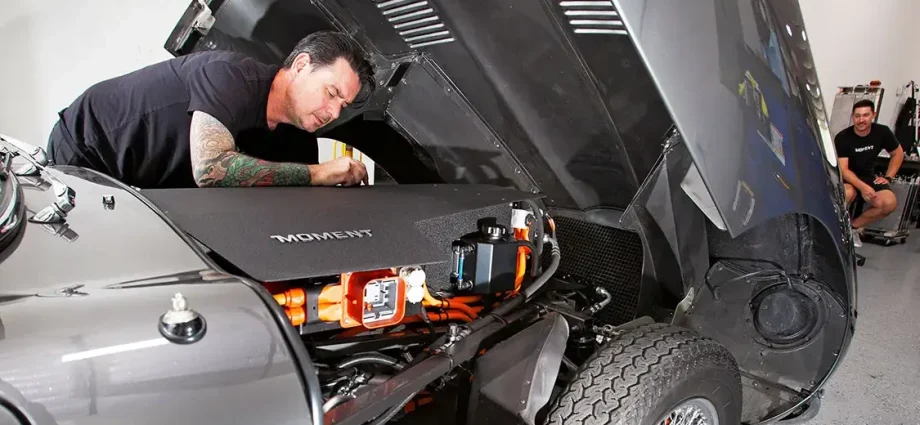
So, you’re thinking about electrifying your classic. That’s a big, exciting, and honestly, a slightly daunting leap. It’s not just swapping an engine for a battery pack—it’s a complete reimagining of your beloved machine. But where do you even start? Well, let’s dive in. This guide isn’t about selling you a kit; it’s about giving you the map for the journey ahead.
Why Go Electric? It’s More Than Just Gas Prices
Sure, never stopping at a gas station again is a perk. But the real magic of an EV conversion, or a “restomod” as it’s often called, is transformative. Imagine instant, silent torque that breathes new life into a 60s cruiser. Think about reliability—no more points, carbs, or distributor caps. Just turn the key and go. It’s about preserving the soul and style of a classic while giving it the heart of the future. And, you know, it’s a pretty incredible project.
The First, Most Critical Step: Choosing Your Donor Car
Not every classic is a perfect candidate. Here’s the deal: you want a car with a solid body and frame. Rust repair is a nightmare on its own; adding a complex EV drivetrain on top is a recipe for a project that never ends. Lightweight cars are your friend—they need less power to move, which means smaller, cheaper components. Popular choices include the Volkswagen Beetle, Porsche 911, Ford Mustang, and classic Minis. They have space, community support, and relatively simple layouts.
Avoid overly complex classics with tight engine bays or rare, numbers-matching vehicles that might be better left original. The goal is enhancement, not erasure of history.
Key Considerations for Your Donor:
- Weight & Balance: Batteries are heavy. You need a chassis that can handle the weight distribution shift.
- Available Space: Where will the battery pack go? The trunk? The transmission tunnel? Under the hood?
- Braking & Suspension: The added weight means you’ll likely need to upgrade these systems. It’s non-negotiable for safety.
Understanding the Core Components: The EV “Guts”
Let’s break down the major pieces you’ll be working with. Think of it like a recipe—you need the right ingredients in the right proportions.
| Component | What It Does | Key Decision Points |
| Electric Motor | Provides propulsion. AC motors are more efficient; DC can be simpler. | Power (kW), torque, RPM, physical size. Do you want a direct drive or keep a transmission? |
| Battery Pack | The fuel tank. Stores energy as DC power. | Voltage (system voltage), capacity (kWh), chemistry (Li-ion NMC or LFP), packaging, and cooling. |
| Motor Controller | The brain. Manages power from battery to motor. | Must match motor type (AC/DC) and system voltage. Features like regen braking are controlled here. |
| Charger & DC-DC Converter | Refuels the pack and powers 12V systems. | Charging speed (Level 1, 2), onboard or offboard. DC-DC replaces the alternator. |
| Adaptor Plate & Coupling | Connects the motor to the existing transmission (if used). | Custom machining is often required. A critical interface piece. |
The Battery Conundrum: Range vs. Cost vs. Space
This is your biggest cost and your biggest headache. Lithium-ion is the standard, but even within that, you have choices. New cells are expensive but come with warranties and peace of mind. Used modules from wrecked EVs can slash costs—but you need to really know what you’re doing with battery management systems (BMS).
You must design a pack that fits your car and your driving. A 20kWh pack might get you 70 miles in a light car; 40+kWh gives you real-world range. But every kWh adds weight, cost, and physical bulk. It’s a constant, tricky balancing act.
The Phased Approach: A Step-by-Step Conversion Roadmap
Okay, you’ve got a car and a pile of parts. Now what? Here’s a typical workflow. Don’t skip steps.
- Deconstruction: Carefully remove the internal combustion engine, fuel tank, exhaust, and associated systems. Label everything. Take a million photos.
- Assessment & Prep: Now, with the car empty, fix any rust, upgrade brakes (to disc if possible), and refresh the suspension. This is the time.
- Mock-up & Fabrication: This is the hands-on core. Build battery box mock-ups. Figure out motor mounting. Fabricate brackets, adaptor plates, and coolant lines. It’s a puzzle.
- Electrical Integration: The scary part for many. You’re running high-voltage cabling (in ORANGE conduit!), installing the BMS, and integrating the new EV components with the car’s original 12V system for lights, wipers, etc.
- Software & Testing: Programming the controller, setting up the instrument cluster (or a new screen), and then… cautious, methodical testing. First, just see if it moves under its own power in the garage.
Real Talk: The Challenges and Pitfalls
It’s not all instant torque and quiet cruising. Be ready for this.
Cost can spiral. Budget for twice the time and 1.5x the money you initially think. Custom fabrication and unexpected parts add up fast.
It’s a steep learning curve. You’ll need mechanical, electrical, and fabrication skills. Or deep pockets to pay someone who has them.
Safety is paramount. Working with high-voltage electricity is no joke. One mistake can be fatal. If you’re not 100% confident, hire a professional for the high-voltage work. Seriously.
Is a Kit the Right Path for You?
For many first-timers, a conversion kit is a godsend. Companies like EV West, Electric Classic Cars, and others offer kits for specific models. They bundle matched components and provide mounting hardware. It reduces the engineering guesswork. But they’re not cheap, and they still require significant labor and integration. They’re a guided path, not a turn-key solution.
The Final Connection: More Than Just a Car
Completing an EV conversion is… profound. You’ve not just restored a piece of history; you’ve recontextualized it. You’ve given it a new voice—a whisper instead of a roar. The connection you feel to that machine is different. It’s a testament to problem-solving, patience, and a certain kind of optimistic vision.
It makes you wonder: what is the soul of a car? Is it the sound of the exhaust, or the feeling of the road, the shape in the rearview mirror, the story it tells? Converting a classic to electric forces you to answer that question for yourself. And the answer, when you finally drive it, is surprisingly clear.